Stop AI Pilot Collapse: How to Align Your AI Ambitions with Your Org's Capabilities
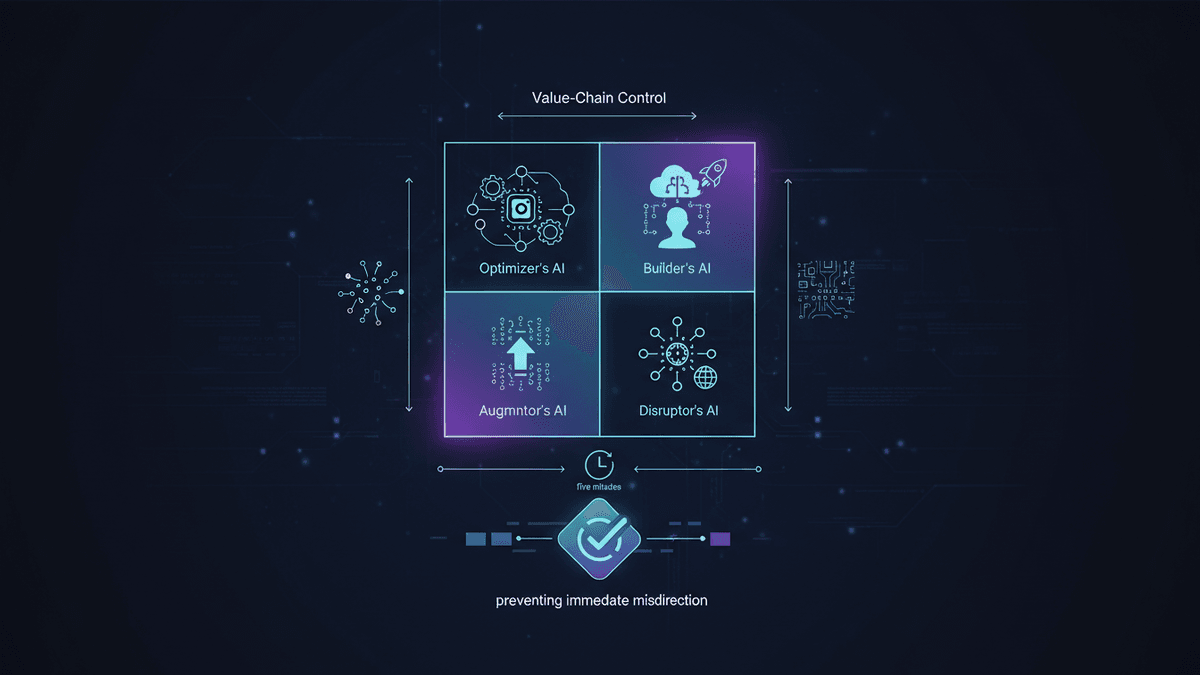
Before committing to any new AI pilot, spend five minutes plotting your company's current 'value-chain control' and 'technological breadth' on a simple 2x2 grid to quickly identify which of the four HBR AI strategic archetypes best fits your reality, preventing immediate misdirection.
An AI-optimized product, 40% lighter and 20% stronger, was shelved by General Motors. Its revolutionary design, however, proved incompatible with GM’s supply chain. This exemplifies a critical trap for leaders: investing in AI pilots that end in "pilot collapse"—costly experiments that never scale. The problem isn't AI's potential, but a fundamental misalignment with existing operating models, value chains, and internal capabilities. This disconnect wastes capital and forfeits competitive advantage when AI ambitions outrun reality.
A new Harvard Business Review framework (2026) offers a practical solution. It guides leaders to assess their organization’s AI readiness, enabling them to choose strategies that deliver tangible business value aligned with their unique operational reality. This approach prevents expensive missteps and ensures AI investments scale effectively.
Preventing AI Pilot Collapse
The GM case study is a stark reminder: many organizations pursue AI based purely on technical potential, overlooking their capacity to integrate innovations into existing processes. This creates a significant gap between what the technology can do and what the organization is equipped to do.
Pilot collapse stems from overlooking crucial factors: value-chain control, technological infrastructure, and operational agility. When AI initiatives demand radical overhauls without strategic fit, they invariably falter. Resources are consumed, yet full-scale deployment and meaningful return on investment remain elusive.
The HBR 2x2 AI Strategy Matrix
This HBR framework plots AI strategy across two critical dimensions:
- Value-Chain Control: Your organization's influence over the product or service journey from conception to market—do you control most steps or rely heavily on external partners?
- Technological Breadth: The range and interdependence of technologies your company integrates—is your core technology highly specialized, or do you manage a broadly interconnected tech stack?
Mapping your organization against these axes reveals one of four strategic archetypes for sustainable AI adoption.
Four AI Strategic Archetypes
- Focused Differentiation: (High Control, Low Breadth) Companies with tight control over specialized value chain segments leverage AI to enhance core competencies for unique, targeted value.
- Vertical Integration: (High Control, High Breadth) Organizations managing broad, integrated technologies across their value chain use AI to optimize end-to-end processes and data flow, demanding robust internal capabilities.
- Collaborative Ecosystem: (Low Control, High Breadth) Companies relying on extensive partner networks, integrating diverse technologies without owning the full value chain, apply AI to emphasize interoperability and leverage external platforms.
- Platform Leadership: (Low Control, Low Breadth) Entities operating within a specialized tech niche influencing a broader ecosystem use AI to develop foundational tools or data capabilities, building network effects.
Your AI Strategy Action Plan
To achieve sustained AI success, apply this framework:
- Assess Value-Chain Control: Quantify your current ‘value-chain control.’
- Evaluate Technological Breadth: Map your existing ‘technological breadth,’ considering interconnectedness and scope.
- Identify Your Archetype: Plot these assessments on the 2x2 grid to pinpoint your most suitable AI strategic archetype.
- Review & Align Initiatives: Review all planned AI pilots against your identified archetype. Align or reconsider to prevent wasted capital and effort.
- Develop a Reality-Based Roadmap: Create a phased AI integration roadmap that respects your current operating model and supply chain realities, prioritizing a pragmatic approach over immediate retooling.
The ultimate success of your AI strategy hinges not on technological ambition alone, but on a deep understanding of your unique organizational reality. This ensures that even the most ambitious AI designs can be effectively built, integrated, and scaled.
Ready to make smarter, scalable AI investments that deliver real business impact? Use this HBR framework to rigorously assess your organizational reality and chart a sustainable AI strategy. Join our exclusive community for deeper insights and peer discussion.